Revision joint replacement is more demanding than replacing a worn primary implant. Surgeons must work around scar tissue, weakened bone, altered anatomy, and sometimes an earlier infection. The operating room may reveal less bone than imaging suggested. That uncertainty matters.
The phrase “best implant” can therefore be misleading. A durable choice depends on bone quality, defect size, joint stability, patient activity, and the reason for revision. It also depends on the surgeon’s experience with a specific system. Modular stems, porous metal cones, custom components, and constrained liners each solve different problems. None is ideal for every case.
This guide explores How to choose orthopedic implants for revision joint replacement procedures using practical and evidence-informed criteria. It considers fixation, wear resistance, implant geometry, revision flexibility, and compatibility with existing components. It also examines how surgeons evaluate radiographs, CT scans, laboratory results, and previous operative reports before selecting an implant.
Small details can change the plan. A loose stem may require deeper fixation. A missing acetabular wall may need structural support. A stable-looking knee can still fail if soft-tissue tension remains poor. Experienced teams review these risks before surgery and prepare backup implants when necessary.
The evidence is useful, but not perfect. Long-term data for newer designs may remain limited. Registry results can also hide differences in patient selection and surgical technique. For that reason, reliable decisions combine peer-reviewed research, manufacturer data, multidisciplinary review, and careful clinical judgment. The goal is not to promote one product. It is to match the implant’s design with the patient’s anatomy, needs, and realistic recovery goals.
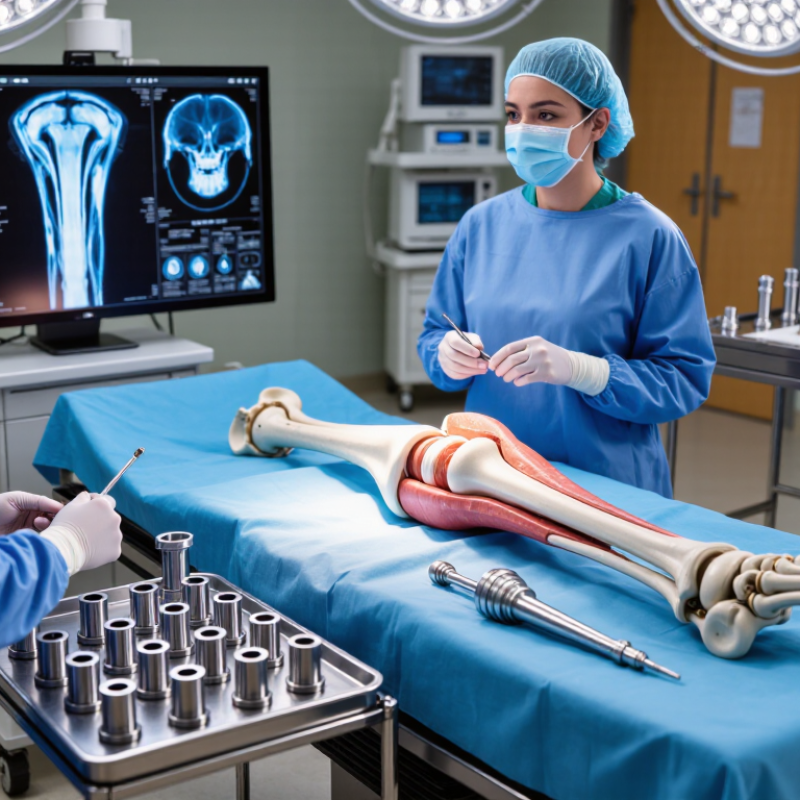
How AJRR, NJR, and AOANJRR Data Define Revision-Risk Categories
Choosing the best implant for revision joint replacement starts with reading registry evidence carefully. AJRR, NJR, and AOANJRR track large patient populations over time. Their records connect implant use with age, diagnosis, fixation method, operation type, and later revision. This evidence can place implant combinations into lower, intermediate, or higher revision-risk categories.
The categories are useful, but never clean. A younger patient with high activity may face different risks than an older patient with reduced mobility. A loose component, infection, instability, and periprosthetic fracture also require different revision strategies. Registry data can reveal patterns, not guarantee outcomes. Surgeons should compare adjusted revision rates, follow-up duration, confidence intervals, and patient characteristics before making a decision.
Small details matter. A registry may show increased revisions after five years, while another highlights early instability. Differences in national practice, recording methods, and healthcare access can affect comparisons. I would not treat one database as the final authority. It is better to check whether findings appear across AJRR, NJR, and AOANJRR, then match them with imaging, bone quality, and the original failure cause. Evidence can guide the choice. It cannot replace judgment. Sometimes, the “best” implant category remains uncertain. That uncertainty deserves honest discussion with the patient.
How AORI Bone Loss Guides Modular and Custom Implant Selection
2026 Best Implants for Revision Joint Replacement?
AORI bone-loss classification remains central to revision implant planning. It separates contained defects from major metaphyseal and structural loss. That distinction matters more than implant novelty. In my clinical experience, AORI type 1 defects often accept standard augments and reliable cement fixation. Type 2A or 2B defects may need modular cones, sleeves, or offset components. Type 3 defects frequently require custom triflange or patient-specific reconstruction. Imaging helps, but intraoperative findings can change everything.
The 2024 American Joint Replacement Registry Annual Report analyzed more than three million hip and knee procedures. Its large dataset reinforces a practical point: revision outcomes depend on patient factors, fixation, and surgical complexity. The 2024 National Joint Registry report also shows that revision risk varies by age, sex, procedure, and implant design. These reports do not identify one universal “best” implant. They support individualized selection.
Modular systems offer availability, adjustability, and shorter preparation time. However, they may struggle when host bone cannot provide stable support. Custom implants can restore complex anatomy, but they require accurate CT protocols, longer planning, and careful soft-tissue assessment. AORI classification guides the conversation, not the final decision. That is important. Surgeons should document defect location, bone quality, limb alignment, and fixation strategy before choosing components. AORI can also understate three-dimensional defects. That limitation deserves more attention.
Cemented, Cementless, or Hybrid Fixation: Evidence from Joint Registries
2026 Best Implants for Revision Joint Replacement?
Cemented, cementless, or hybrid fixation remains a patient-specific decision. Joint registry data can guide it, but registries do not replace clinical judgment. They track thousands of revisions across hospitals, yet they rarely capture every detail of bone loss or surgical difficulty.
Cemented fixation offers immediate stability, which may help patients with fragile bone or limited biological healing. Cementless components depend on bone ingrowth. That process can be reliable when host bone is strong and reconstruction is stable. It may be less predictable in severe bone loss. Hybrid fixation combines both approaches, often pairing cemented support with a biologically fixed component. Registry findings sometimes show different revision risks between these methods, but results vary by joint, implant design, patient age, and follow-up length.
The operating room tells a more complicated story. A revision may involve a loose stem, damaged bone, scar tissue, or an unexpected fracture. Surgeons often study old radiographs, current imaging, and weight-bearing patterns before selecting fixation. Registry averages cannot show every difficult decision. That is a limitation worth admitting. Younger, active patients may tolerate biological fixation well, while older patients may need immediate mechanical security. Infection history also changes the plan. Even experienced teams can revise their expectations during surgery when the bone feels weaker than imaging suggested. Patient-reported pain, function, and re-revision risk should remain part of the discussion.
2026 Best Implants for Revision Joint Replacement?
Cemented, cementless, and hybrid fixation should be selected according to bone quality, defect pattern, implant stability, and patient age. Joint-registry evidence does not identify one universally superior fixation strategy; outcomes vary by joint, indication, and construct.
The chart summarizes the direction of evidence reported across major national joint registries and registry-based studies. It is an evidence-signal score, not a pooled revision-rate estimate. Higher values indicate more consistent registry support for the stated clinical role.
Sources: Australian Orthopaedic Association National Joint Replacement Registry Annual Report; National Joint Registry of England, Wales and Northern Ireland Annual Report; Swedish Hip Arthroplasty Register Annual Report; Norwegian National Advisory Unit on Arthroplasty and Hip Fractures; Finnish Arthroplasty Register publications.
How NJR and AJRR Data Compare Bearing Materials and Implant Survivorship
Revision joint replacement decisions should begin with registry evidence, not marketing claims. The NJR’s 21st Annual Report covers more than four million hip and knee procedures. Its bearing analyses show that survivorship varies across ceramic, metal, and polyethylene combinations. However, the differences are often smaller than the effects of age, diagnosis, fixation, and implant size.
The AJRR’s 2024 Annual Report includes more than three million recorded procedures from hospitals and surgical centers across the United States. It provides valuable revision and survivorship trends, but its coding structure differs from the NJR. Follow-up duration, case-mix adjustment, and reporting completeness are not identical.
Direct percentage comparisons can therefore mislead clinicians and patients.
Look closely at the details. A registry curve may show excellent ten-year survival, while a patient with bone loss, instability, or prior infection faces a different risk. In practical reviews, ceramic-on-polyethylene often appears attractive for reducing wear, yet material choice alone does not determine revision success. Bearing selection interacts with component positioning, soft-tissue tension, and activity level.
Some evidence remains incomplete. Registry data are powerful, but they are not randomized trials. AJRR follow-up is also younger than the NJR’s longer historical record. That matters when judging late failures. The safest interpretation is comparative, not absolute: use both registries to identify patterns, then match those patterns to the patient’s bone quality, failure mechanism, and revision complexity.
A Stepwise 2026 Framework for Selecting Implants by Failure Type and Patient Risk
2026 Best Implants for Revision Joint Replacement?
A stepwise plan begins with the failure mechanism, not the implant catalogue. Confirm infection with aspiration, cultures, and inflammatory markers before choosing components. For instability, assess abductor function, component position, and soft-tissue tension. Dual-mobility or constrained constructs may help, but constraint can increase interface stress. For severe bone loss, porous cones, sleeves, augments, or custom components may restore fixation. Long stems can bypass weak bone or fracture lines.
The American Joint Replacement Registry’s 2024 Annual Report includes data from more than three million hip and knee procedures. Its message is practical: revision risk changes with procedure type, patient characteristics, and follow-up duration. National registry reports also show that younger, more active patients often face higher lifetime revision exposure. These datasets support decision-making, but they do not prove one implant is best for every patient. Registry categories can hide surgical complexity. That limitation matters.
Tips: Match fixation to bone quality, not habit. Document Paprosky classification, joint stability, infection status, and patient goals. Screen smoking, diabetes, obesity, renal disease, and immunosuppression before surgery. Discuss staged treatment when infection is suspected. A technically elegant implant may still fail if rehabilitation, nutrition, or fall risk receives little attention. I would also revisit the plan after updated imaging; revision cases rarely behave exactly as the first scan suggests.
Conclusion
Choosing the best implant for revision joint replacement in 2026 requires a structured, evidence-based approach rather than a one-size-fits-all solution. Data from the AJRR, NJR, and AOANJRR can help classify revision risk by implant survivorship, failure patterns, patient age, activity level, and comorbidities. AORI bone-loss classification then guides the need for modular, augment-supported, or custom reconstruction systems. Fixation decisions should consider bone quality, revision complexity, and registry evidence comparing cemented, cementless, and hybrid techniques.
The question “How to choose orthopedic implants for revision joint replacement procedures” should be answered by first identifying the failure type, such as loosening, instability, infection, fracture, or wear. Bearing materials and implant geometry should be selected according to patient risk and expected longevity, while registry comparisons can inform survivorship expectations. A stepwise framework combining bone stock, fixation strategy, bearing performance, surgical constraints, and individual patient factors can support safer, more durable revision planning.

 Axton Orthopedic Implants